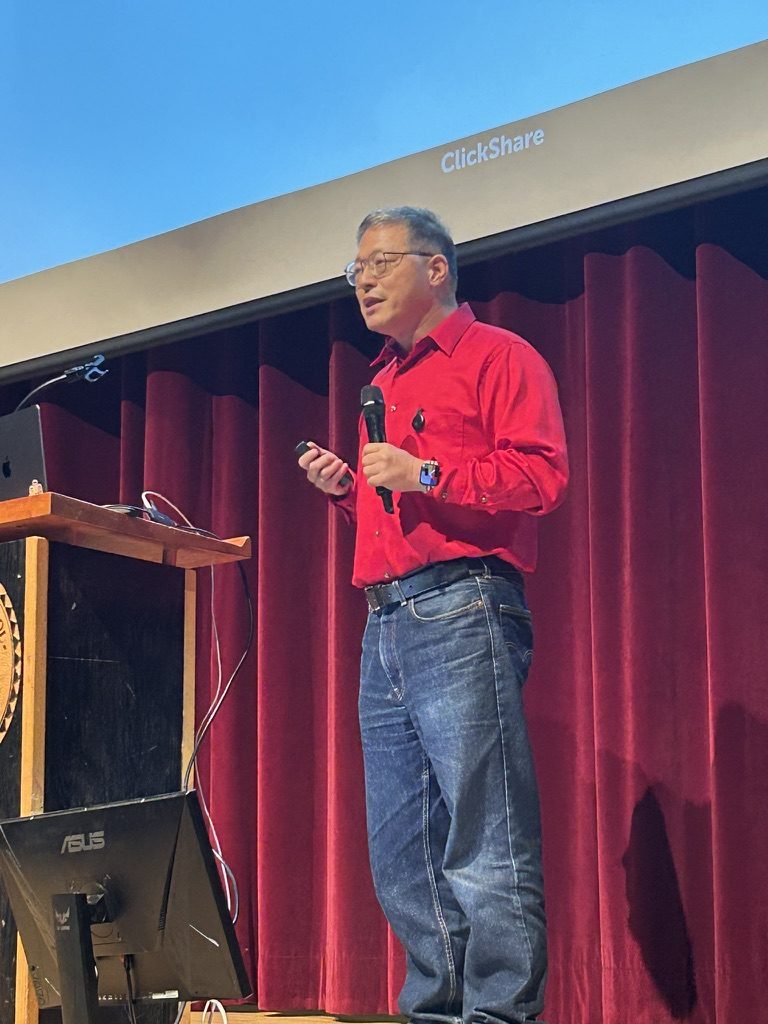
AI keynotes and faculty workshops, from someone still in the classroom.
I help schools build AI fluency in their faculty and their students.
My talks come from a classroom I am still standing in, not a slide deck from five years ago. I work with schools as a keynote speaker, a faculty PD leader, and a consultant on AI strategy.
Douglas spent his sabbatical in my lab at MIT, working as a teacher in residence, and helping us think about the future of teacher learning. He's a tremendous educator for teachers and students, and a pleasure to collaborate with.
— Justin Reich, Director, MIT Teaching Systems Lab
What I offer
Three ways to work together. Most schools start with a keynote and add workshop time the same day or the same season.
Keynotes
A single talk that gives your faculty a shared starting point on AI, matched to the moment your school is in.
Each talk is built for a different room. Tell me which one your faculty is, and I will tell you which talk fits.
Signature talk
You've Been Training for This for Fifty Years
The Original Prompt Engineers
Computer scientists spent the last decade making the shift teachers made fifty years ago: from sage on the stage to guide on the side, from writing the rules to designing the conditions where learning happens. Alison Gopnik says the goal is to raise new, intelligent, autonomous creatures, which has always been a teacher's job and never a programmer's. In the age of AI, care and empathy stop being the soft skills and become the essential ones. Faculty leave seeing themselves as the original prompt engineers, not beginners.
Best for: an opening faculty day, or any audience that needs to feel capable rather than behind.
Don't Let the Pigeon Drive the Bus
Managing AI in a Human-Centered World
AI is the pigeon, and it will always ask to drive. Can I rewrite this? Can I take the wheel? The skill worth teaching is the film director's: never touch the camera, but hold the vision and decide what gets reshot. As agents take over the execution, a student's real work becomes defining where the bus is going and judging whether the work that came back is any good. Come and experience a teacher's-eye view of what's working, what isn't, and what comes next.
Best for: a forward-looking audience thinking about agents and student judgment.
My Mother Became a Songwriter in Her Eighties
The Keyboard Was Never the Point
My mom wrote lyrics in her eighties, then used AI to turn them into a Hawaiian slack key song, complete with a vocalist singing in accurate Hawaiian. She never learned music or the language. The barrier to making the thing she heard in her head dropped to zero. This talk holds the honest tension of that moment, whether it counts and whether it was earned, and arrives at the question that matters more than the answer: when the role shifts from player to director, what are we actually asking students to master?
Best for: a creativity, arts, or humanities audience. The emotional centerpiece talk.
We Didn't Ask for This
AI wasn't an educational initiative. It was thrust on schools with no pilot, no planning time, no professional development, and no say in the matter, and it makes the gold rush look like a piñata grab. Teachers are losing assignments and methods they built careers around, and the five stages of grief apply for real. This talk gives faculty permission to feel the loss before asking them to move, the same way the best teachers met the pandemic by starting from what they already knew. You'll see how students can use AI as a creative collaborator without surrendering the thinking that makes their work their own, and you'll leave with practical strategies for designing assignments where AI raises the ceiling instead of lowering the floor.
Best for: a resistant, exhausted, or skeptical faculty.
Don't Ask, Don't Tell
Survey your freshmen and your faculty and you find the same gap every time. Students use AI almost daily without thinking about it. Teachers think carefully about it and barely use it. The danger isn't open AI use, it's hidden use, because students size up every new teacher to figure out who gets it and who doesn't, and they go quiet with the ones who don't. The fix starts the day a teacher says out loud, here's how I've used AI and here's what surprised me, what are you noticing? I'll tackle the questions keeping educators up at night: When does AI help students learn, and when does it just help them finish? How do we teach ownership in an age of infinite generation? And how do we stay honest about what we don't yet know?
Best for: a school ready to set honest classroom AI norms.
Faculty Workshops & PD
Offered in half-day and full-day formats, customized by combining the topics below to fit your school's professional learning goals.
AI & Digital Literacy
Teaching AI Literacy to Faculty and Students.Faculty leave with a toolkit of lessons and activities for every level, drawn from a data-driven PD model and a required AI-literacy course for incoming freshmen.
Creating with AI: Writing, Images, and Video.A hands-on tour of generative tools, with best practices and the ethics of originality and creative control.
Prompt and Context Engineering.Craft effective prompts and supply the right context to get reliable results, across any discipline or skill level.
Writing with AI.An emerging practice and what current research suggests about helping students become better storytellers.
Pedagogy & Equity
Differentiating Evaluation.Two models for assessing student work, one mastery and competency-based, one using journals and work logs, with templates you can adapt.
Engaging Students in STEM.Research-based strategies for building belonging and retention through meaningful collaboration and community.
Mix and Match
Any of these can be folded into a custom half-day or full-day: Design Thinking, AI-assisted writing and critical thinking (humanities focus), AI for People Who Hate AI (a non-threatening introduction), coding with AI (Dr. Vibecode), AI for your workflow (planning, feedback, differentiation), and Simulations with AI (virtual tutors and coaches).
Watch
Spaces Between: Teaching, Learning, and Community
About Douglas
Douglas Kiang has taught english and computer science for more than 30 years and still does it every day, currently at Menlo School in Silicon Valley, where he built the AI literacy course every freshman takes. His talks come from a classroom he's still standing in, not a slide deck from five years ago. He served on the development committee for AP Computer Science Principles, authored Apple's Develop in Swift curriculum for teachers, and earned a master's from Harvard's Technology, Innovation, and Education program, where he also taught CS50. An Apple Distinguished Educator, he has spoken at ISTE and keynoted international conferences from Beijing to Riga, and he's a recipient of the NCWIT Educator Award for getting more young women into computing.